

What Is a Bulging Disc? Causes, Symptoms, and Treatment Options in Grand Rapids MI
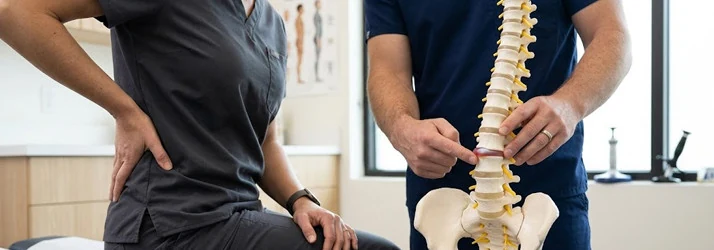
You bend down to pick up a laundry basket, and a dull ache settles into your lower back. A few days later, the discomfort begins to spread into your buttock or down your leg. When your MRI results arrive, you notice an unfamiliar phrase: “Disc bulge at L4-L5.” If you are exploring bulging disc treatment options in Grand Rapids MI, understanding your symptoms is an important first step.
Seeing those words can be worrying, especially when you don't know what they mean.
But a bulging disc isn't always a serious problem. Many people have disc bulges without feeling any pain. Even when symptoms occur, they can often improve with appropriate non-surgical care.
So, what is a bulging disc, what causes it, and how can you find relief?
This guide explains what happens inside your spine, how to recognize possible symptoms, and which treatments may help you move more comfortably.
Table of Contents
- What Is a Bulging Disc in Grand Rapids MI?
- How Common Are Bulging Discs?
- What Are the Types of Bulging Discs?
- What Does a Bulging Disc Look Like?
- Bulging Disc vs. Herniated Disc: What's the Difference?
- What Are the Signs and Symptoms of a Bulging Disc?
- What Causes a Bulging Disc? Possible Causes and Risk Factors
- When Should I See a Doctor About My Bulging Disc Symptoms?
- How Is a Bulging Disc Diagnosed?
- Conservative Treatment for a Bulging Disc
- Surgical Treatment for a Bulging Disc
- Recovery: How Long Does It Take for a Bulging Disc to Heal?
- What Can You Do at Home for a Bulging Disc?
- Frequently Asked Questions
- Final Thoughts
- Chiropractic Care in Grand Rapids MI
- Innovative Health & Chiropractic
- About the Author
What Is a Bulging Disc in Grand Rapids MI?
Your spine contains 24 movable bones called vertebrae. Between most of these bones are soft, flexible discs that act like cushions. They help absorb shock and allow your back to bend, twist, and move.
Each disc has two main parts:
- Annulus fibrosus: A strong outer ring made of layers of fibrous tissue.
- Nucleus pulposus: A softer, gel-like center that helps distribute pressure.
A bulging disc happens when part of a spinal disc extends outward beyond its usual boundary.
Think of a hamburger patty that's slightly larger than its bun. The patty spreads past the edges without necessarily breaking apart. A bulging disc behaves somewhat similarly.
In many cases, this change develops gradually as the disc loses water and flexibility with age.
Does a bulging disc always cause pain?
No. A bulging disc may cause no symptoms at all. Pain, tingling, or weakness can develop if the disc irritates nearby nerves or contributes to narrowing around them.
The location of the bulge and your symptoms matter more than the MRI finding alone.
How Common Are Bulging Discs?
Bulging discs are more common than many people realize, especially as we get older.
A 2015 systematic review published in the American Journal of Neuroradiology looked at spinal imaging findings in 3,110 people who had no back pain.
Researchers estimated that disc bulges were present in approximately:
- 30% of people at age 20
- 50% of people at age 40
- 69% of people at age 60
- 84% of people at age 80
These are estimates from research involving people without symptoms, not predictions of who will develop pain.
This tells us something important: finding a bulging disc on an MRI does not automatically mean it is causing your discomfort.
A healthcare professional needs to compare imaging results with your symptoms, medical history, and physical examination.
What Are the Types of Bulging Discs?
Bulging discs are often described by their location in the spine and by how the disc extends outward.
Types Based on Location
Lumbar bulging disc (lower back)
Lumbar disc bulges often develop at L4-L5 or L5-S1, where the lower spine handles considerable movement and load.
When nearby nerves become irritated, symptoms may include lower-back pain, tingling, or discomfort traveling into the buttock or leg.
Cervical bulging disc (neck)
Cervical disc bulges affect the neck, commonly around C5-C6 or C6-C7.
Depending on nerve involvement, they may cause neck pain, shoulder discomfort, or symptoms extending into the arms and hands.
Thoracic bulging disc (mid-back)
Thoracic disc bulges affect the middle part of the spine. They are less common than cervical or lumbar disc bulges.
Some may cause localized mid-back discomfort, although many produce no symptoms.
Types Based on Shape
A circumferential or symmetric bulge extends around a broad portion of the disc. An asymmetric bulge extends farther in one area than another.
The shape alone does not determine how serious the problem is. A smaller change near a nerve can sometimes cause more symptoms than a larger bulge elsewhere.
What Does a Bulging Disc Look Like?
You cannot see a bulging disc by looking at someone's back. It is an internal change that may appear on medical imaging.
On an MRI, a disc normally fits between two vertebrae. A bulging disc extends beyond the edges of those bones, usually over a broad area.
Sometimes, the disc also appears darker on certain MRI images because it has lost some water content.
Educational visual references: spinal disc anatomy and MRI appearance. A clinician must interpret actual imaging findings alongside symptoms and examination results.
Can an X-ray Show a Bulging Disc?
Not directly. X-rays primarily show bones and spinal alignment. They may reveal reduced space between vertebrae, but they cannot clearly show the disc itself.
MRI provides more detail about discs, nerves, and other soft tissues.
However, an MRI is not necessary for every person with back pain. Imaging is most useful when the results may change the treatment plan or when concerning symptoms require investigation.
Bulging Disc vs. Herniated Disc: What's the Difference?
Many people ask, is a bulging disc the same as a herniated disc?
No. Although both involve changes to a spinal disc, they describe different patterns.
A bulging disc extends outward over a broad area of its outer boundary. A herniated disc occurs when disc material becomes displaced through a more localized area of the outer ring.
A bulging disc is often associated with gradual age-related changes. Herniation can develop through degeneration or injury.
Both conditions may cause back pain, neck pain, numbness, or symptoms traveling into an arm or leg. However, either condition can also exist without symptoms.
A herniated disc is not automatically more serious than a bulging disc. What matters most is whether a nerve is affected, how severe your symptoms are, and whether neurological problems such as weakness are present.
It is also important to understand that a bulging disc does not inevitably turn into a herniated disc.
What Are the Signs and Symptoms of a Bulging Disc?
Some people have a bulging disc for years without noticing anything unusual.
Others develop pain or nerve-related symptoms, depending on where the disc is located.
Possible signs and symptoms include:
- A dull or aching pain in the lower back or neck
- Pain traveling into the buttock, leg, or foot
- Discomfort spreading into the shoulder, arm, or fingers
- Tingling or a pins-and-needles feeling
- Numbness in part of an arm or leg
- Muscle weakness
- Muscle tightness or spasms near the painful area
These symptoms are not unique to bulging discs. Other conditions can produce similar discomfort.
What Does a Bulging Disc Feel Like?
Imagine sitting at your desk for an hour and noticing that your lower back is becoming stiff. When you stand up, you feel an ache or a sharp pain traveling toward your hip or leg.
For some people, that is what a symptomatic disc problem feels like.
Others describe burning, shooting, or electric-like pain. Coughing, sneezing, bending, or sitting for a long period may make certain nerve-related symptoms worse.
Some feel better after walking or changing positions. Others find that lying down provides temporary relief.
The important point: The symptoms depend on which structures are irritated. You cannot diagnose a bulging disc from how the pain feels alone.
What Causes a Bulging Disc? Possible Causes and Risk Factors
Most bulging discs develop gradually rather than from one sudden injury.
As you age, spinal discs naturally lose some water and elasticity. This can make them less flexible and more likely to extend beyond their usual boundaries.
Several factors may contribute.
Age-Related Changes
Over time, discs become less hydrated and may lose some of their ability to handle pressure. This is one reason disc bulges appear more frequently in older adults.
Repetitive Physical Stress
Repeated bending, twisting, and heavy lifting can place stress on spinal structures, especially when the body has little time to recover.
Lifting and Movement Habits
Awkward or poorly controlled lifting can sometimes trigger back symptoms. However, ordinary bending or imperfect posture does not automatically cause a disc bulge.
Injury or Trauma
A fall, sports injury, or car accident may contribute to disc damage in some cases.
Bulging Disc Risk Factors
Factors associated with disc degeneration or back problems include genetics, smoking, excess body weight, physically demanding work, and previous spinal injuries.
Long periods of inactivity may also reduce muscle strength and physical conditioning, making everyday activities feel more difficult.
You cannot control every risk factor. However, regular movement, physical conditioning, smoking cessation, and safe lifting habits may support long-term spine health.
When Should I See a Doctor About My Bulging Disc Symptoms?
Mild back discomfort often improves with time and sensible self-care. However, persistent or worsening symptoms should not be ignored.
Schedule a healthcare evaluation if your pain lasts more than a week or two without improving, travels into your arm or leg, or interferes with work, sleep, or normal activities.
New numbness or weakness should be assessed promptly rather than waiting for it to improve on its own.
When Is a Bulging Disc an Emergency?
Go to the nearest emergency department immediately if you develop:
- New difficulty starting urination or loss of bladder control
- Loss of bowel control
- Numbness around your groin, genitals, or inner thighs
- Severe or rapidly worsening weakness in your legs
These symptoms may indicate a serious nerve problem, including cauda equina syndrome, which requires emergency assessment.
How Is a Bulging Disc Diagnosed?
A bulging disc diagnosis involves more than looking at an MRI.
Your healthcare professional will first ask when the pain started, where you feel it, and what makes it better or worse.
They may also examine your posture, movement, strength, reflexes, and sensation to look for signs of nerve involvement.
Do You Always Need an MRI?
No. Many uncomplicated back-pain episodes can be assessed and managed without immediate imaging.
An MRI may be recommended when symptoms suggest significant nerve compression, neurological problems are getting worse, serious conditions are suspected, or imaging could change treatment decisions.
A useful evaluation connects three things: your symptoms, the physical examination, and any imaging findings.
Conservative Treatment for a Bulging Disc
If you're wondering how to fix a bulging disc, the answer usually starts with managing symptoms and improving movement, not rushing into surgery.
Many people with disc-related pain improve using conservative care. The most appropriate treatment depends on the symptoms, examination findings, and whether nearby nerves are affected.
Chiropractic Care
Chiropractic care may help some patients manage mechanical back pain and improve movement through appropriately selected manual techniques.
At Innovative Health & Chiropractic, Dr. Cory Wellman, D.C., offers individualized chiropractic care.
A chiropractor may assess spinal movement, muscle function, and daily activities before determining whether manual care is suitable.
Spinal manipulation is not appropriate for every patient, especially when there are progressive neurological symptoms or other serious warning signs. It should not be presented as a way to physically push a bulging disc back into place.
Non-Surgical Spinal Decompression
Non-surgical spinal decompression uses equipment designed to apply controlled pulling forces to the spine.
Some patients seek this treatment for disc-related discomfort.
However, research has not clearly established that traction reliably reverses disc bulges or provides lasting benefits beyond recommended care. Major clinical guidance does not recommend routine traction for low-back pain or sciatica.
Innovative Health & Chiropractic lists spinal decompression among its relevant services. Patients should discuss its limitations, possible risks, and suitability with a qualified clinician before starting treatment.
Myofascial Release
Myofascial release is a hands-on approach focused on muscles and the surrounding connective tissue.
It may be used to address muscle tightness or discomfort associated with back pain.
Although it cannot repair a damaged disc, soft-tissue techniques may help some people feel more comfortable as part of a broader care plan.
SoftWave Therapy
SoftWave Therapy is another service listed for Innovative Health & Chiropractic.
It uses acoustic-wave technology and may be considered for certain musculoskeletal concerns.
However, evidence specifically supporting SoftWave Therapy as a treatment for bulging discs is limited. It should not be described as a proven method for repairing discs or relieving nerve compression.
Exercise and Physical Rehabilitation
Gentle exercises and progressive strengthening are important parts of many recovery plans.
Depending on your symptoms, a clinician may suggest walking, improving hip mobility, strengthening supporting muscles, or gradually returning to normal activity.
Exercise should be adjusted to your comfort and ability. Stop an activity and seek advice if it causes increasing radiating pain, numbness, or weakness.
Other Non-Surgical Options
Other approaches may include short-term activity changes, heat or cold for comfort, and appropriate over-the-counter pain medicines when safe.
For severe or persistent nerve pain, a physician may consider epidural injections in selected cases.
The goal is not simply to change what the MRI looks like. It is to reduce symptoms, restore useful movement, and help you return to everyday activities.
Surgical Treatment for a Bulging Disc
Surgery is generally not the first treatment for a bulging disc.
It may become an option when symptoms remain severe despite appropriate non-surgical care, imaging confirms a problem that fits the symptoms, or nerve function is seriously affected.
Depending on the underlying condition, surgical procedures may include microdiscectomy, laminotomy, laminectomy, or foraminotomy to relieve pressure on nerves.
Spinal fusion or artificial disc replacement may be considered for certain spinal conditions, but they are not routine treatments for a simple disc bulge.
Every procedure has potential benefits, risks, and recovery requirements.
A spine specialist can explain whether surgery is appropriate based on your symptoms, medical history, and imaging results.
People with certain serious neurological symptoms may require urgent surgery rather than a prolonged trial of conservative care.
Recovery: How Long Does It Take for a Bulging Disc to Heal?
Recovery varies from person to person.
Some people begin feeling better within a few weeks, while others need several months to regain comfortable movement.
Many episodes of associated back pain or sciatica improve over weeks to months, but there is no guaranteed six- or twelve-week recovery deadline.
Recovery depends on the location of the disc change, possible nerve irritation, overall health, symptom severity, and response to care.
Can a Bulging Disc Heal Completely?
Sometimes symptoms improve even though the disc still appears enlarged on an MRI.
Inflammation and nerve irritation may settle, allowing you to return to normal activities without the disc completely returning to its earlier shape.
That means successful recovery does not always require a perfectly normal-looking MRI.
Staying active within your limits, gradually improving strength, and following an appropriate care plan may support recovery.
What Can You Do at Home for a Bulging Disc?
When your back hurts, it's natural to want to rest until the pain disappears.
But spending too much time in bed can lead to stiffness and reduced conditioning.
Try these practical habits while recovering:
- Take short walks. Begin with a comfortable distance and increase gradually as symptoms allow.
- Change positions regularly. Avoid sitting or standing in one position for long periods.
- Modify painful activities. Temporarily reduce movements that clearly worsen your symptoms.
- Use heat or cold for comfort. Choose whichever provides relief without irritating your skin.
- Return to exercise gradually. Follow a suitable strengthening and mobility plan.
- Avoid smoking. Quitting can support your overall health and reduce an important risk factor for disc degeneration.
You do not need perfect posture every minute of the day. Comfortable movement, regular activity, and gradually building physical strength are usually more useful goals.
If you notice increasing nerve pain, numbness, or weakness, seek professional guidance rather than trying increasingly intense stretches at home.
Frequently Asked Questions
Can a bulging disc heal on its own?
Can you walk with a bulging disc?
Is sitting bad for a bulging disc?
How do I know if a bulging disc is pressing on a nerve?
Can chiropractic care help with a bulging disc?
Will I need surgery for a bulging disc?
Final Thoughts
Learning what a bulging disc is can make an unfamiliar MRI finding feel less frightening.
A bulging disc does not automatically mean you have a serious spinal condition or that surgery is in your future.
Many disc changes are part of aging, and many people who experience symptoms improve with time, appropriate movement, and conservative treatment.
The next step is understanding what is actually causing your discomfort.
If back or neck pain is affecting your daily life, a professional evaluation can help you explore suitable care options and identify when additional medical attention is needed.
Chiropractic Care in Grand Rapids MI
If you're experiencing ongoing back stiffness, neck discomfort, or difficulty moving comfortably, Innovative Health & Chiropractic offers individualized chiropractic care in Grand Rapids, Michigan.
Dr. Cory Wellman, D.C., focuses on understanding each patient's needs and selecting care suited to their symptoms and goals.
Depending on your examination and needs, available services to discuss include chiropractic care, spinal decompression, myofascial release, SoftWave Therapy, and wellness care.
Not every treatment is appropriate for every spinal condition, and an evaluation can help determine whether chiropractic care or a referral to another medical professional is the better choice.
Innovative Health & Chiropractic
Address: 6651 Crossings Dr SE, Suite B, Grand Rapids, MI 49508
Phone: (616) 888-8161
Website: Chiropractor in Grand Rapids MI
Map: Innovative Health & Chiropractic
About the Author
Dr. Cory Wellman, D.C.
Dr. Cory Wellman leads Innovative Health & Chiropractic with a patient-focused approach to chiropractic care, rehabilitation, and wellness. He provides individualized care designed around each patient's needs and goals, emphasizing comfortable movement and better daily function.
Dr. Wellman works with children, teenagers, adults, and older adults. His approach combines chiropractic care with rehabilitation and muscle-focused techniques when appropriate.
At Innovative Health & Chiropractic, his goal is to provide a high standard of patient experience through care plans tailored to the individual rather than relying on a one-size-fits-all approach.

OFFICE HOURS
Monday
8:00am - 6:00pm
Tuesday
11:00am - 7:00pm
Wednesday
8:00am - 4:00pm
Thursday
11:00am - 7:00pm
Friday
9:00am - 12:00pm
Saturday & Sunday
Closed

Innovative Health & Chiropractic
6651 Crossings Dr SE Ste B
Grand Rapids, MI 49508