

Is a Chiropractor a Real Doctor? | Education & Training in Grand Rapids MI
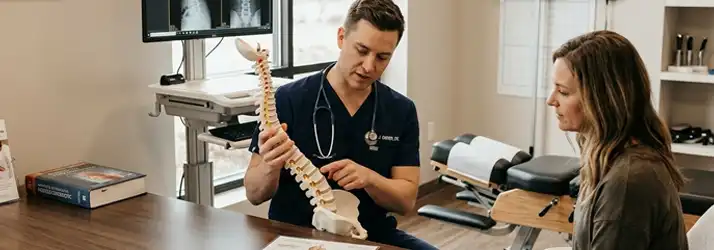
Seeing “Dr.” before a chiropractor’s name can raise a simple question: Is a chiropractor a real doctor in Grand Rapids Mi? Yes, a chiropractor can earn a professional doctoral degree, but that does not mean they are a medical doctor.
Chiropractors earn a Doctor of Chiropractic (D.C.) degree after completing specialized professional education and clinical training. Their education focuses heavily on the spine, joints, muscles, movement, and other parts of the musculoskeletal system.
Medical doctors follow a different path. They earn an M.D. or D.O. degree, complete medical school, and typically continue with residency training.
Knowing the difference can help you understand what a chiropractor does, what training they receive, and which type of healthcare professional may be right for your needs.
What Is Chiropractic Care in Grand Rapids MI?
Chiropractic care is a healthcare profession that focuses mainly on the musculoskeletal system, including the spine, joints, and muscles.
People may visit a chiropractor for concerns such as:
- Back pain
- Neck pain
- Joint stiffness
- Muscle tension
- Limited movement
- Certain headaches
- Sports-related discomfort
- Injuries that affect movement
A chiropractic visit may begin with a discussion of your health history, symptoms, daily activities, and goals. The chiropractor may then perform an examination and assess movement, posture, or joint function.
Depending on the patient and the provider’s legal scope of practice, care may include spinal adjustments, joint techniques, soft-tissue work, rehabilitation exercises, stretching, and movement recommendations.
At Innovative Health & Chiropractic in Grand Rapids, MI, the practice offers chiropractic care along with services such as SoftWave Therapy, spinal decompression, myofascial release, and wellness care.
Is a Chiropractor a Real Doctor?
Yes. A chiropractor who has completed a Doctor of Chiropractic program holds a professional doctoral credential.
The important thing to understand is that doctor does not describe only one healthcare profession. Different healthcare professionals can earn different doctoral degrees.
For example:
- D.C. - Doctor of Chiropractic
- M.D. - Doctor of Medicine
- D.O. - Doctor of Osteopathic Medicine
These degrees are not the same. Each one has its own education, clinical training, licensing requirements, and scope of practice.
So, is a chiropractor a real doctor? Yes, when the person has earned a D.C. degree and meets the requirements to practice. The title does not mean the chiropractor has completed medical school or is an M.D. or D.O.
Is a Chiropractor a Medical Doctor?
No. A chiropractor is generally not a medical doctor.
An M.D. or D.O. completes medical school and typically goes on to residency training. A chiropractor completes a professional chiropractic program that leads to a D.C. degree.
There can be overlap in subjects such as anatomy, physiology, and other sciences, but the purpose of the training is different.
Medical physicians receive broad medical education and may later specialize in areas such as family medicine, internal medicine, pediatrics, neurology, or surgery. Chiropractors receive specialized education centered on chiropractic care and the musculoskeletal system.
The legal scope of chiropractic practice can also vary from one state to another.
Is a Chiropractor Considered a Doctor?
Yes. A properly educated and licensed chiropractor is considered a doctor of chiropractic.
When people ask, “is a chiropractor considered a doctor,” the clearest answer is to look at the specific professional degree. A D.C. identifies a Doctor of Chiropractic, while an M.D. or D.O. identifies a medical physician.
This difference is important because the word “doctor” by itself does not tell you what type of healthcare professional you are seeing.
When choosing a provider, it is helpful to look at their degree, license, experience, and scope of practice rather than relying only on the title “Dr.”
What Kind of Doctor Is a Chiropractor?
So, what kind of doctor is a chiropractor?
A chiropractor is a Doctor of Chiropractic.
Chiropractic programs provide education in areas such as anatomy, physiology, neurology, pathology, biomechanics, clinical sciences, imaging, and chiropractic techniques. Students also receive hands-on clinical education as part of their professional training.
This education prepares chiropractors to work within their field and evaluate patients with musculoskeletal concerns.
For someone dealing with back pain, neck discomfort, joint stiffness, or movement problems, a chiropractic evaluation may help determine whether chiropractic care is appropriate.
Meet Dr. Cory Wellman, D.C.
Dr. Cory Wellman, D.C., is the chiropractor at Innovative Health & Chiropractic in Grand Rapids, MI. The practice provides personalized chiropractic care along with rehabilitation and other supportive services.
The clinic works with patients across different age groups and activity levels and focuses on creating care that fits the individual rather than using the exact same approach for everyone.
Patients can learn more about Dr. Wellman, the practice, and available services through the Innovative Health & Chiropractic website.
What Is the Chiropractic Degree?
The Chiropractic Degree is commonly called the Doctor of Chiropractic (D.C.) degree.
Students in a chiropractic program complete academic, laboratory, and clinical education. Their coursework can cover subjects such as:
- Human anatomy
- Physiology
- Biochemistry
- Neurology
- Pathology
- Biomechanics
- Clinical assessment
- Imaging
- Chiropractic techniques
- Patient care
The goal is to prepare graduates for professional chiropractic practice.
A Chiropractic Degree should not be described as an M.D. or D.O. degree. It is a separate professional qualification for the chiropractic profession.
Chiropractors: Specialized Education, Extensive Clinical Experience
Becoming a chiropractor involves more than learning how to perform adjustments.
Students receive education in basic sciences and clinical subjects and gain supervised experience working with patients. This helps future chiropractors learn how to:
- Take a patient history
- Perform appropriate examinations
- Evaluate musculoskeletal concerns
- Understand movement and joint function
- Develop an appropriate care plan
- Use chiropractic techniques
- Recognize when referral or additional medical evaluation may be needed
This is specialized training for chiropractic practice. It is not the same as medical school and physician residency because the two professions prepare students for different roles.
DC Training Path
The DC Training Path generally includes several stages.
1. Complete Prerequisite Education
Students usually complete required college coursework before entering a chiropractic program. Admission requirements vary by school.
2. Enter a Doctor of Chiropractic Program
Students enroll in a professional chiropractic program that leads to a D.C. degree.
3. Complete Classroom and Clinical Education
Students study the sciences and clinical subjects while developing hands-on skills through supervised training.
4. Complete Required Examinations
Graduates must meet the examination requirements established by the state where they plan to practice.
5. Obtain a State License
After meeting education and examination requirements, graduates apply for a chiropractic license under state law.
6. Maintain Professional Requirements
Licensed chiropractors may also need to complete continuing education or other requirements to maintain their license.
Steps to Become a Chiropractor
The Steps to become a Chiropractor can vary by state, but the general path includes:
- Complete required college coursework.
- Meet the admission requirements for a chiropractic program.
- Earn a Doctor of Chiropractic degree.
- Complete supervised clinical training.
- Pass required licensing examinations.
- Apply for state licensure.
- Complete continuing education when required.
A degree alone does not automatically give someone the right to practice. State licensure is an important part of becoming a practicing chiropractor.
Do Chiropractors Go to Medical School?
A common question is, “Do Chiropractors Go to Medical School?”
Generally, no.
Chiropractors attend chiropractic programs instead of medical schools that award M.D. or D.O. degrees.
There is some overlap in foundational science education, but the professional training has different goals.
Medical school prepares students for the practice of medicine. Chiropractic programs prepare students for chiropractic practice.
Medical doctors typically continue into residency after medical school. Chiropractors follow a separate educational and licensing pathway.
MD vs DC: The Big Differences
Understanding MD vs DC: The Big Differences can make the distinction much easier to understand.
- Doctor of Chiropractic (D.C.)
- Earns a Doctor of Chiropractic degree
- Receives specialized chiropractic education
- Focuses primarily on chiropractic and musculoskeletal care
- Uses chiropractic and conservative approaches within scope
- Licensed as a chiropractor
- Completes chiropractic clinical education
- Medical Doctor (M.D.)
- Earns a Doctor of Medicine degree
- Receives broad medical education
- Trained to manage a wide range of medical conditions
- May use medications, procedures, or surgery depending on specialty
- Licensed as a physician
- Typically completes residency after medical school
D.O.s are also medical physicians and follow a medical education and residency pathway.
The difference is not about one profession being “real” and the other being “fake.” The difference is the type of education, training, and professional authority associated with each credential.
How Are Medical Doctors Different Than Chiropractors?
Medical doctors are trained to diagnose and manage a broad range of diseases and medical conditions. Depending on their specialty, they may prescribe medications, provide hospital care, perform procedures, or conduct surgery.
Chiropractors are trained primarily in chiropractic care and musculoskeletal health. Their care may include spinal adjustments, joint techniques, rehabilitation, movement recommendations, and other conservative approaches allowed within their scope of practice.
A chiropractor does not replace a medical doctor for every health concern. In some situations, a patient may need medical evaluation, testing, or treatment from another healthcare professional.
The right provider depends on the patient’s symptoms, health history, diagnosis, and individual needs.
Are Chiropractors Licensed?
Yes. Chiropractors must meet the licensing requirements of the state where they practice.
Requirements can include:
- Completing an approved chiropractic education program
- Passing required examinations
- Meeting state application requirements
- Following professional regulations
- Completing continuing education when required
Patients can verify a provider’s license through the appropriate state licensing agency.
Licensing matters because it shows that a practitioner has met the requirements established by the state for legal chiropractic practice.
What Does It Mean to Be a Chiropractor?
Being a chiropractor means completing professional chiropractic education, gaining clinical experience, meeting licensing requirements, and practicing within the appropriate scope.
A chiropractor may work with people who have back pain, neck discomfort, joint stiffness, movement limitations, sports-related concerns, and other musculoskeletal problems.
At Innovative Health & Chiropractic, Dr. Cory Wellman and his team provide personalized chiropractic care and additional services that may support movement, rehabilitation, and wellness. The clinic serves patients in Grand Rapids and the surrounding community.
What Can a Chiropractor Do?
A chiropractor can provide care within the scope allowed by their education and state license.
Depending on the patient and the practice, chiropractic care may include:
- Spinal adjustments
- Joint mobilization
- Soft-tissue techniques
- Rehabilitation exercises
- Movement recommendations
- Posture guidance
- Wellness support
Innovative Health & Chiropractic also offers services including spinal decompression, SoftWave Therapy, and myofascial release as part of its broader approach to patient care.
Why Your Chiropractor’s Credentials Matter
When choosing a chiropractor, it is reasonable to ask about education, licensure, clinical experience, and treatment approach.
You may also want to ask:
- What did you find during my examination?
- What type of care are you recommending?
- What is the goal of treatment?
- How often will I need to return?
- When should my progress be reassessed?
- Would another healthcare professional be appropriate for my condition?
Clear communication can make it easier to understand your options and make informed decisions about your care.
When Should You See a Medical Doctor?
Chiropractic care may be appropriate for many musculoskeletal concerns, but it is not the right option for every health problem.
You should seek medical evaluation when symptoms could indicate a serious medical condition or when your needs fall outside a chiropractor’s scope of practice.
Seek urgent medical attention for symptoms such as:
- Sudden weakness or paralysis
- Trouble breathing
- Severe chest pain
- Loss of consciousness
- New difficulty speaking
- Major trauma
- Loss of bladder or bowel control
- Rapidly worsening neurological symptoms
- Severe or unusual headache
- High fever with severe symptoms
When you are unsure about the cause of your symptoms, appropriate medical evaluation is important.
Chiropractic Care in Grand Rapids, MI
If you are looking for chiropractic care in Grand Rapids, MI, it is worth choosing a practice where you can ask questions and understand your care plan.
Innovative Health & Chiropractic is located at 6651 Crossings Dr SE, Suite B, Grand Rapids, MI 49508. The practice provides chiropractic care and additional services focused on movement, rehabilitation, and wellness.
Dr. Cory Wellman, D.C., provides care through the practice and works with patients across different ages and activity levels.
Have questions about chiropractic care? Contact Innovative Health & Chiropractic in Grand Rapids, MI, to learn more or schedule a consultation.
Frequently Asked Questions
Chiropractic care is a healthcare profession focused mainly on the spine, joints, muscles, and other parts of the musculoskeletal system. Care may include adjustments, joint techniques, rehabilitation, and other conservative approaches.
Final Thoughts
A licensed chiropractor who has earned a Doctor of Chiropractic degree holds a professional doctoral credential.
At the same time, a chiropractor is not a medical doctor simply because they use the title “Dr.” Chiropractors, M.D.s, and D.O.s follow different educational pathways and have different professional scopes.
The easiest way to remember the difference is:
D.C. = Doctor of Chiropractic
M.D./D.O. = Medical Physician
Understanding this difference can help you choose the right type of healthcare professional for your needs.
If you are looking for personalized chiropractic care in Grand Rapids, MI, Innovative Health & Chiropractic can help you learn more about your options and whether chiropractic care may be appropriate for your situation.

OFFICE HOURS
Monday
8:00am - 6:00pm
Tuesday
11:00am - 7:00pm
Wednesday
8:00am - 4:00pm
Thursday
11:00am - 7:00pm
Friday
9:00am - 12:00pm
Saturday & Sunday
Closed

Innovative Health & Chiropractic
6651 Crossings Dr SE Ste B
Grand Rapids, MI 49508